Break your CDC pipeline on purpose
A lab that kills the consumer mid-batch, poisons the topic, and replays a consumer group — plus the bug this pipeline shipped with and how I found it.
You do not understand a pipeline until you have broken it
Reading about at-least-once delivery is easy. Believing it is different. The gap between the two is closed by one thing: watching your own pipeline survive a failure you caused on purpose.
This is part 3 of the CDC series. Part 1 built the path from the Postgres WAL to ClickHouse; part 2 explained why duplicates are harmless by design. This post is the lab that proves both — and the bug that taught me more than any feature did.
Everything below runs against the
repo with four
containers: make up, make register-connector, make consume.
Lab 1: kill the consumer mid-batch
The claim from part 2 is that write-then-commit turns a crash into a replay, and the merge absorbs it. Test it by making batches tiny and killing the process mid-drain.
CDC_BATCH_SIZE=1 CDC_CONSUMER_GROUP=lab-kill \
  cdc consume --max-messages 100 &      # one row per batch
sleep 4 && kill -9 $!                   # hard crash: no graceful flush
kill -9 matters. A graceful shutdown runs the finally block, flushes the buffer, and commits —
which is the happy path, not the failure you are testing. SIGKILL simulates the crash.
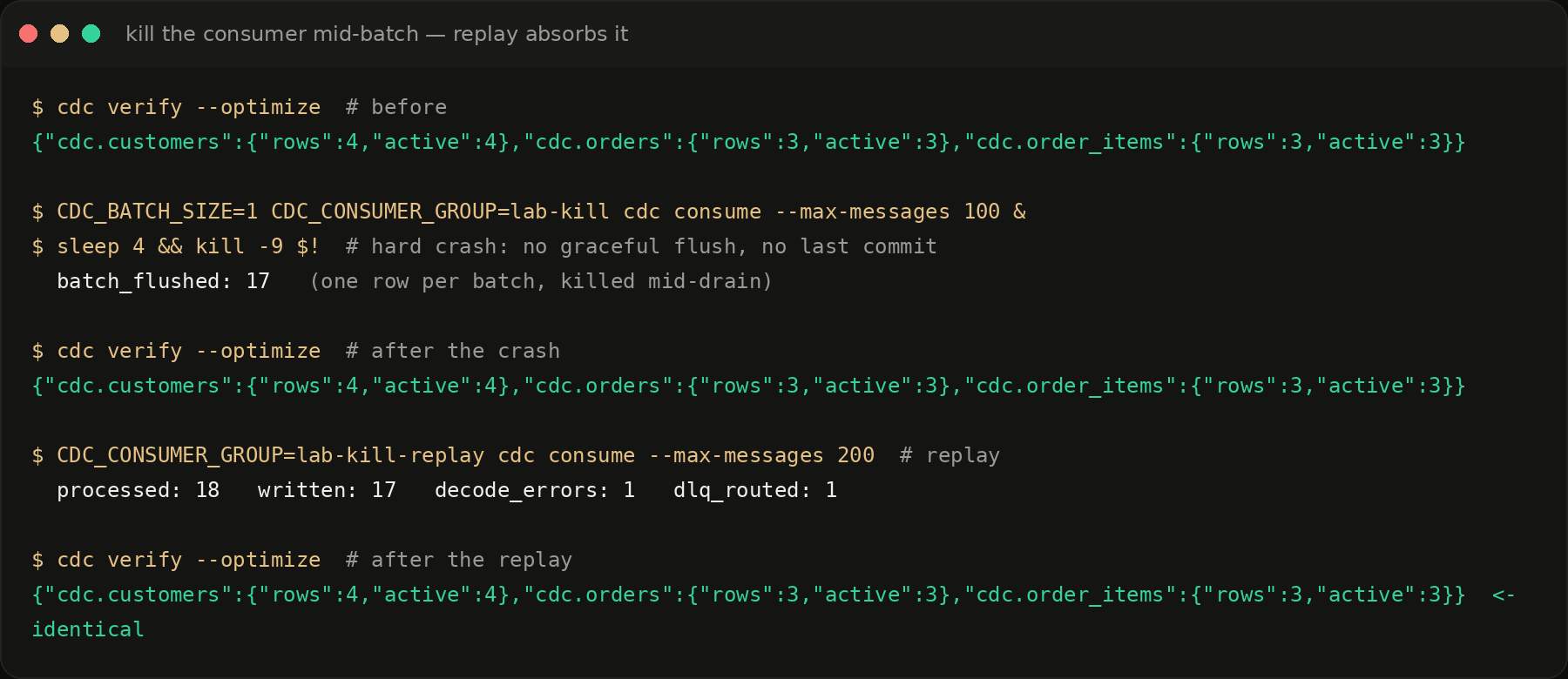
The counts never move. The interrupted batch was redelivered on the next run, and the versioned merge made the duplicate a no-op. Prediction check: if you expected “at least one duplicate row in ClickHouse”, you were right — and it was invisible, which is the point.
Lab 2: poison the topic
A malformed message is the most common real-world failure: a producer ships a bad payload, and the consumer dies on every restart, stuck replaying the same poison message forever. A pipeline that cannot make progress because of one bad record is a pipeline with a single point of failure.
Send something that is not JSON, then consume with a fresh group:
echo 'this is not json' | rpk topic produce shopdb.public.customers \
  --key '{"customer_id":999}'
CDC_CONSUMER_GROUP=lab-dlq cdc consume --max-messages 50
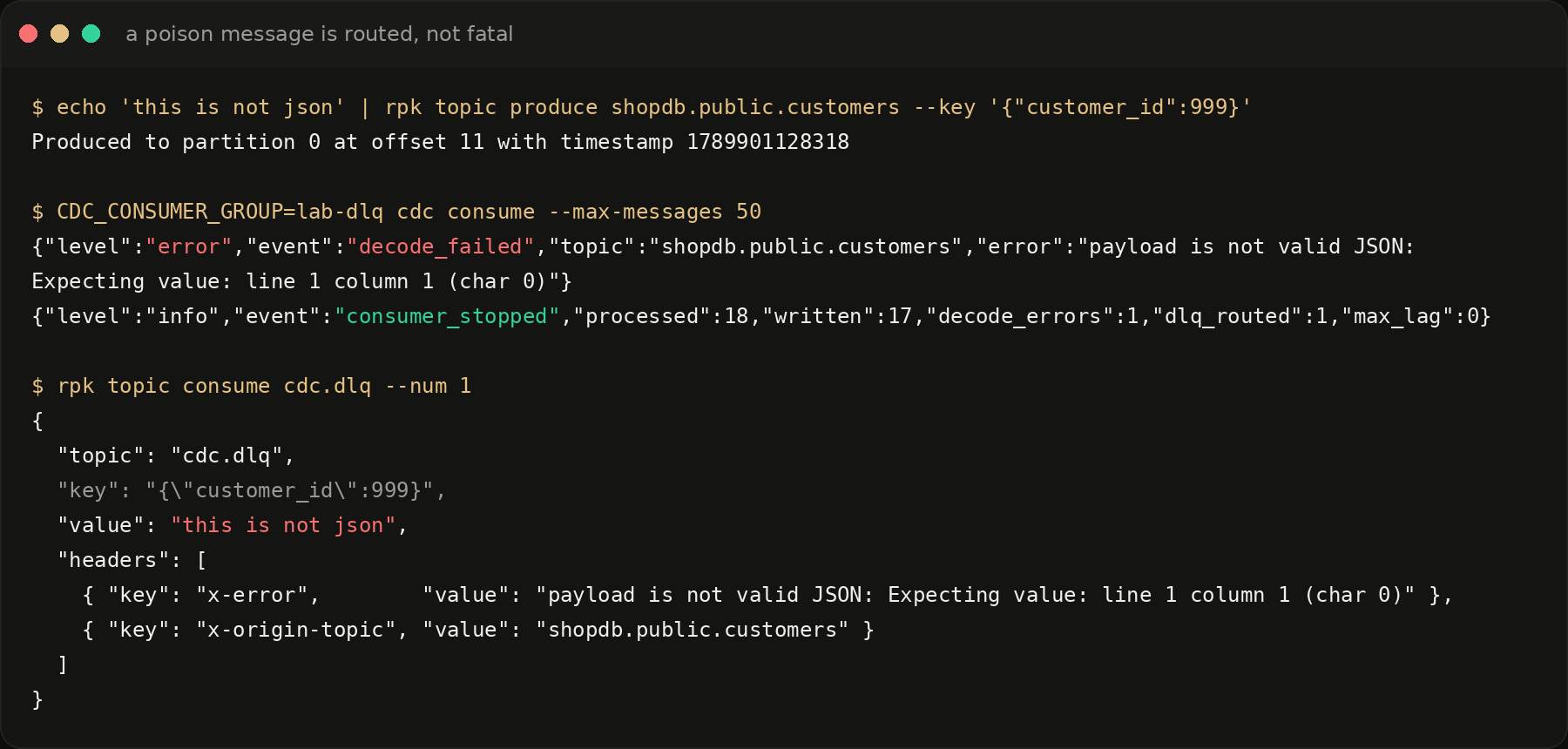
The run processed 18 messages, wrote 17, logged one decode_failed, and kept going. The bad payload
landed in cdc.dlq with two headers that make triage possible:
x-error— why it was rejected (payload is not valid JSON)x-origin-topic— where it came from
That is the difference between “the pipeline is stuck” and “the pipeline is running; here is the 1 record that needs a human.”
Lab 3: replay a consumer group
The strongest test of idempotency is not a crash — it is replaying the entire log. A brand-new consumer group reads from the beginning, so every event is delivered a second time.
cdc verify --optimize                       # baseline
CDC_CONSUMER_GROUP=lab-idem-1 cdc consume --max-messages 200
CDC_CONSUMER_GROUP=lab-idem-2 cdc consume --max-messages 200
cdc verify --optimize                       # must be unchanged
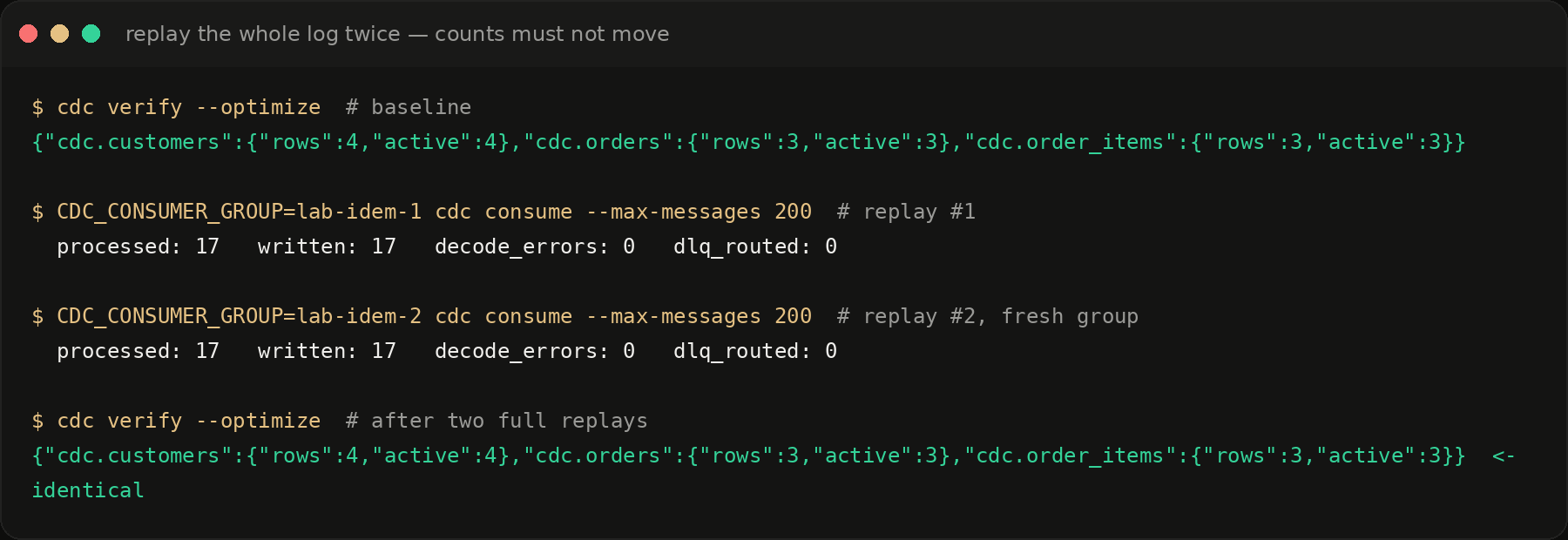
Two complete replays, 34 writes, and the merged table is byte-for-byte the same as before. This is what “effectively-once” means in practice: not that the events are delivered once, but that delivering them n times has the same result as delivering them once.
Bonus lab: pause the connector
One more guarantee worth checking is upstream. Pause the connector, write to Postgres, resume:
curl -X PUT localhost:8083/connectors/shop-postgres-connector/pause
psql -c "UPDATE customers SET city='Surabaya' WHERE customer_id=1;"
curl -X PUT localhost:8083/connectors/shop-postgres-connector/resume
The event still arrives after the resume. The replication slot held its position, so a paused connector loses nothing — which is precisely why the slot is also the thing that fills your disk if nobody drains it. Convenience and risk, same mechanism.
The bug this pipeline shipped with
Now the part that matters more than any lab.
Symptom: cdc consume --max-messages 20 ran for five minutes and printed nothing.
Why the symptom lied: I piped the output through tail. tail buffers until the process exits,
so the real signal was not “no output” — it was “the process never exits.” Silence in a terminal is
usually a buffering artifact, not a missing log line. I lost ten minutes to that alone.
The actual defect was four lines in the poll loop:
while max_messages is None or self.metrics.processed < max_messages:
    message = consumer.poll(poll_timeout)
The topic had 12 messages. The target was 20. poll() returned None forever, processed never
reached 20, and the loop spun indefinitely on an empty topic. An infinite loop with no data is the
worst kind: no exception, no log, no CPU spike — just a process that never finishes.
The lesson: any “wait for N items” loop needs a termination condition that does not depend on the data arriving. The fix was an idle timeout — stop after 15 seconds with no new message, whichever comes first:
elif max_messages is not None and (now - self._last_message_at) >= idle_timeout:
    self.log.info("idle_timeout_reached", idle_seconds=round(now - self._last_message_at, 1))
    break
The regression test uses a fake clock that advances one second per read, so the test exercises the timeout without actually waiting:
def test_bounded_run_stops_on_idle(...):
    ...
    assert metrics.processed == 0          # never reached the target
    assert consumer.closed is True         # but it did stop
Exercise: add a table end to end
The real test of understanding is extending it. Add a products table and trace it through every
layer:
infra/postgres/init.sql— create the table.infra/debezium/postgres-connector.json— add it totable.include.list.src/cdc_pipeline/transforms.py— add anEntitySpec(target, key, columns, types).infra/clickhouse/init.sql— add aReplacingMergeTree(_version, is_deleted)table.make down && make up && make register-connector.- Insert a row,
make consume,make verify.
If that works unaided, you understand the pipeline — including the two places people forget: the connector’s include list, and the ClickHouse engine that makes replay safe.
The cheat-sheet
- Break it on purpose. Reading about guarantees is not the same as watching them hold.
- Use
kill -9, not Ctrl-C, when testing crash safety. - Structured logs are the run’s memory —
run_id, processed, written, errors, lag. - A DLQ turns a stall into a queue. Route poison messages with error context, not silence.
- Replay is the real idempotency test, not a single crash.
- Every “wait for N” loop needs a data-independent exit.
- Distrust silent terminals — check for buffering before concluding “nothing happened.”
Check yourself
Check yourself
- Why does
kill -9test something different from Ctrl-C in lab 1?Answer
Ctrl-C triggers the graceful shutdown path, which flushes the buffer and commits before exiting — the happy path. SIGKILL skips all of that, so the last batch is written-but-not-committed (or not written), which is the actual crash window you want to test. - The pipeline logged
decode_failedand continued. What would happen without a dead-letter path?Answer
The consumer would retry the same poison message forever, unable to advance its offset — a single bad record stalls the entire pipeline. Routing it to a DLQ preserves progress and gives a human the context to fix it. - Replaying the whole log twice wrote 34 rows. Why are the counts unchanged?
Answer
Every row carries the source change timestamp as_version, andReplacingMergeTreekeeps only the highest version per key. The replayed rows are older-or-equal versions, so they lose the merge. The writes happened; they just do not change the outcome. - Your bounded drain prints nothing and never exits. What are the two most likely explanations?
Answer
Either the loop’s termination condition depends on data that is not arriving (an infinite poll), or the output is buffered by a pipe/pager so logs exist but are not flushed. Check for buffering first, then audit the loop for a data-independent exit. - Why is the replication slot both a feature and a risk?
Answer
It lets a paused or lagging consumer resume without data loss, because Postgres retains WAL for it. The same retention will fill the primary’s disk if nothing consumes it — so it must be monitored.
The series, and the repo
- Part 1 — Change data capture, explained by building it
- Part 2 — Effectively-once: making a Kafka → ClickHouse sink idempotent
Everything here is runnable, including all eight labs:
github.com/akmalariq/streaming-cdc-pipeline-with-debezium-and-kafka.
References
- Apache Kafka documentation — consumer groups, offsets, and delivery semantics.
- Debezium documentation — the dead-letter topic configuration and
x-errorheaders. - Postgres documentation — replication slots and WAL retention.
Building something with data?
I design and build data platforms, pipelines, and decision dashboards — and I write about how they work.