Effectively-once: making a Kafka → ClickHouse sink idempotent
Kafka only promises at-least-once. Here is how write-then-commit, source-timestamp versions, and ReplacingMergeTree make duplicates harmless — without claiming exactly-once.
“Exactly-once” is usually a marketing word
Ask a streaming pipeline whether it delivers each event exactly once and you will often get a confident yes. Press on it and the answer dissolves. Kafka’s own documentation is careful: producers and consumers give you at-least-once delivery, and exactly-once semantics exist but require transactional producers, transactional consumers, and a broker that supports them — a narrower guarantee than the phrase suggests.
So start from reality: duplicates are going to happen. If a consumer crashes after writing to the sink but before recording its position, the message is redelivered. The question is not how to prevent duplication. It is how to make duplication harmless.
This post is part 2 of the CDC series. Part 1 built the Debezium → Kafka → consumer path; this one is about the guarantee at the end of it. All code is from the runnable repo.
The ordering decision: write first, commit second
Every consumer faces one ordering choice, and it is not symmetric.
def flush(self) -> int:
    written = 0
    for target, rows in self.buffers.items():
        if not rows:
            continue
        written += self.sink.write(target, rows)   # 1. land the data
        rows.clear()

    if written:
        consumer = self._ensure_consumer()
        commit = getattr(consumer, "commit", None)
        if callable(commit):
            commit(asynchronous=False)              # 2. then record the position
            self.metrics.committed += 1
    return written
The alternative — commit the offset, then write — is faster to reason about and wrong:
- Commit then write: crash in between and the message is gone forever. You told Kafka you handled it before you did. This is data loss.
- Write then commit: crash in between and the message is redelivered. You may write it twice. This is replay.
Replay is recoverable. Loss is not. The repo asserts the ordering with a test, because it is exactly the kind of thing a refactor quietly reverses:
def test_flush_writes_before_committing_offsets(...):
    ...
    assert calls == ["write", "commit"]
Version every row
Duplicates are only harmless if the sink can tell which copy is correct. So every row carries a version, and the version is the source change timestamp, not the ingestion time:
row["op"] = event.op
row["source_ts_ms"] = event.source_ts_ms
row["is_deleted"] = 1 if event.is_delete else 0
row["_version"] = event.source_ts_ms
Why the source timestamp rather than now()? Because ingestion order is not business order. Two
consumers replaying the same log can land the same rows in different orders; if the version came from
arrival time, the final state would depend on which copy arrived last. Using the database’s own
change timestamp makes the outcome deterministic: the event that happened later always wins,
regardless of when it was processed.
Let the storage engine resolve the conflict
ClickHouse’s ReplacingMergeTree keeps, per sort key, the row with the highest version. That is the
entire deduplication mechanism:
CREATE TABLE cdc.customers
(
    customer_id   UInt64,
    name          String,
    email         String,
    city          String,
    updated_at    DateTime64(3),
    op            LowCardinality(String),
    source_ts_ms  UInt64,
    is_deleted    UInt8 DEFAULT 0,
    _version      UInt64
)
ENGINE = ReplacingMergeTree(_version, is_deleted)
ORDER BY customer_id;
The two arguments to the engine are doing distinct work:
_version— the row kept per key is the one with the highest version. An old replay loses.is_deleted— the winning row can also carry a deletion flag, which gives soft deletes.
Consequences worth spelling out:
- Replaying an old event is harmless. It has a lower version, so it loses the merge. No
application-level dedup table, no
WHERE NOT EXISTS. - Deletes need no physical
DELETE. A delete becomes a row withis_deleted = 1and the delete’s version. A late replay of the pre-delete row has a lower version and cannot resurrect it. - Merges are lazy.
ReplacingMergeTreecollapses duplicates in the background, not at insert time. Query time is where this becomes visible.
Merges are lazy — so reads must be explicit
Immediately after a write, the table can physically contain several versions of the same key. A naive
count therefore over-reports. The fix is FINAL, which forces merge-on-read:
def count(self, target: str, final: bool = True) -> int:
    suffix = " FINAL" if final else ""
    result = self._client.query(f"SELECT count(*) FROM {target}{suffix}")
    return int(result.result_rows[0][0])
FINAL is not free — it does merge work at query time. For dashboards it is usually the right
default; for high-frequency queries, a materialized view or a scheduled OPTIMIZE TABLE ... FINAL is
better.
The proof
Claims about delivery guarantees should come with a demonstration. The test is simple: read the current counts, replay the entire log twice using two brand-new consumer groups, and read the counts again.
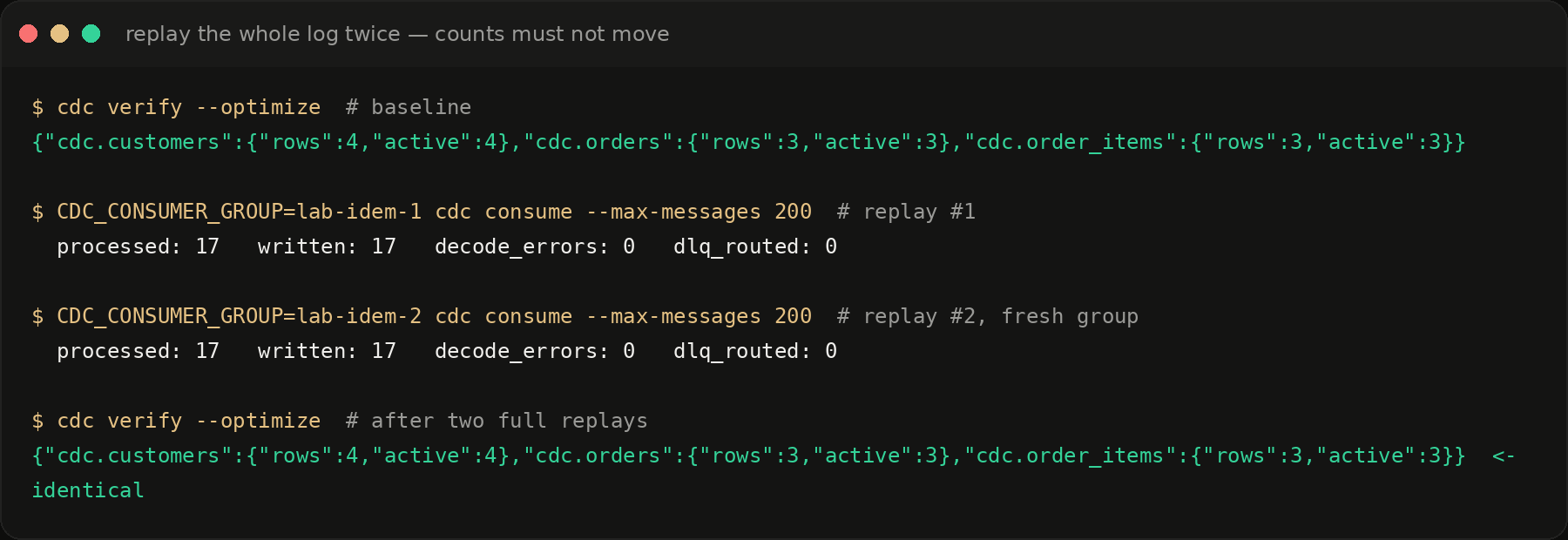
Both replays wrote 17 rows. The merged table did not move — 4 customers, 3 orders, 3 order
items before and after. That is the property, and it is reproducible in the repo with three commands.
Stated honestly
This design gives at-least-once delivery plus an idempotent merge, which behaves like effectively-once. It is not a distributed transaction and it is not true exactly-once. The differences matter:
- No cross-system atomicity. The ClickHouse write and the Kafka offset commit are two separate operations. There is no transaction spanning them.
- Replay is a real, frequent event. It is handled, not eliminated.
- It is a batch committer, not a per-record processor. Buffering by size or interval trades latency for throughput; if you need per-event latency, that is a different design.
- Schema evolution is out of scope here. The connector runs with schemas disabled. A schema registry plus data contracts is the natural next step.
Naming the limitation is part of the design. A pipeline that claims exactly-once and cannot produce a transaction boundary is harder to trust than one that documents its actual guarantee — and easier to break, because nobody looks for the failure mode they were told does not exist.
The cheat-sheet
- Assume at-least-once. Design for duplicates instead of denying them.
- Write before you commit. Prefer replay over loss, every time.
- Version with the source timestamp, never ingestion time.
- Let the engine resolve conflicts:
ReplacingMergeTree(version, is_deleted),ORDER BYthe key. - Soft-delete with a version so late replays cannot resurrect rows.
- Remember merges are lazy — use
FINALwhen you need the merged view. - State the real guarantee. “Effectively-once” is defensible; “exactly-once” usually is not.
Check yourself
Check yourself
- Why is write-then-commit the correct order, even though it can duplicate data?
Answer
Because the two failure modes are not equivalent. Commit-then-write can permanently lose an event; write-then-commit can replay it. Replay is absorbed by the idempotent merge, loss is not recoverable. - Why use
source.ts_msas the version instead of the consumer’s arrival time?Answer
Arrival order is not business order. Replays and multiple consumers can deliver the same rows in different orders; a source timestamp makes “which version is newer” deterministic. With arrival times, the final state could depend on delivery order. - What do the two arguments to
ReplacingMergeTree(_version, is_deleted)each do?Answer
_versionselects the row kept per sort key (highest wins), which absorbs replays.is_deletedlets the winning row mark a deletion, giving soft deletes. - Counts look inflated right after a load. Is the pipeline broken?
Answer
Probably not — merges are lazy. The table can hold multiple versions of a key until background merges run. Query withFINAL(orOPTIMIZE TABLE ... FINAL) to see the collapsed state. - A delete event is replayed after the delete was processed. What happens, and why is that correct?
Answer
The replayed pre-delete row has a lower_versionthan the delete row, so it loses the merge and the row stays deleted. Correctness comes from versioning, not from ordering.
Next in the series
Part 3 makes this concrete by breaking the pipeline on purpose: killing the consumer mid-batch, poisoning the topic, and replaying a consumer group — then watching each guarantee hold. It also includes the bug this pipeline shipped with, which taught me more than any feature did.
The code and the lab are in the repo:
github.com/akmalariq/streaming-cdc-pipeline-with-debezium-and-kafka.
References
- Apache Kafka documentation — message delivery semantics.
- ClickHouse documentation —
ReplacingMergeTreeandFINAL. - Jay Kreps, “Questioning the Lambda Architecture” — on delivery guarantees and replayable logs.
Building something with data?
I design and build data platforms, pipelines, and decision dashboards — and I write about how they work.